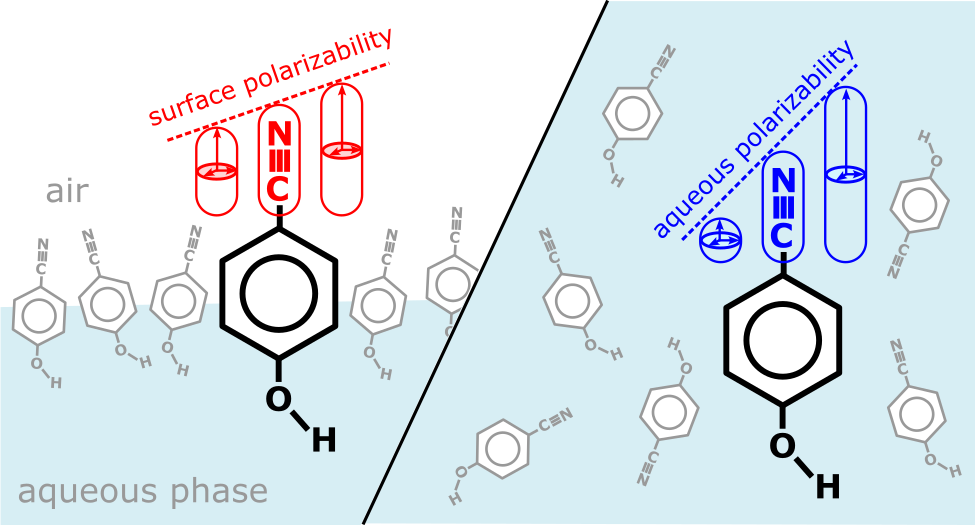
In a recent chalk talk, Aruna Kumarasiri, a chemistry PhD candidate at University of Victoria, shared insights from ongoing research exploring how to study molecular behavior at surfaces without relying on assumptions about molecular orientation. This challenge is central in surface and interface science, where techniques like Sum-Frequency Generation (SFG) vibrational spectroscopy are commonly used but traditionally depend on knowing how molecules are aligned.
The talk described an approach that combines SFG with Raman depolarization ratio measurements to extract meaningful electronic structure information at interfaces. Using p-cyanophenol at the air-water interface as a model system, the team applied different laser polarization schemes (SPS, SSP, PPP) and mathematical models to separate the effects of orientation from the underlying molecular environment.
The results suggest that even without detailed orientation data, it’s possible to learn important things about how molecules behave at interfaces — something that could be useful in fields ranging from environmental science to materials development. The work also points to areas where previous orientation-dependent models might benefit from re-examination.
In addition to this, the speaker briefly discussed some early-stage, unpublished efforts focused on developing a calibration method for the SFG response at buried interfaces — a direction that could improve the accuracy of measurements in systems where direct surface access is difficult.
This research continues to develop, with potential applications in understanding pollutant interactions, improving drug-membrane studies, and designing better surface materials.
If you’re interested in learning more or would like to get in touch, you can visit their website at arunak.net or reach them directly by email at arunak@uvic.ca.
Corresponding publications: